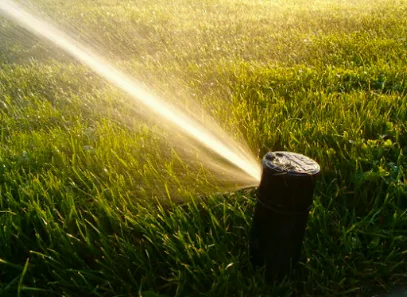
When sprinkler water runs downhill before the zone finishes, divide the watering time into shorter cycles separated by pauses. End each cycle before runoff starts, then use the soil’s response to adjust both the cycle length and the soak interval.
Recognize runoff while the zone is running
Watch the lawn during irrigation rather than judging only by how it looks afterward. Runoff appears as water moving downhill, collecting along the lower edge of a slope, or forming a puddle while the sprinkler is still operating. Those signs show that water is arriving at the surface faster than that patch of soil can take it in at that moment.
Use the first visible movement or pooling as a timing signal. Note how long the zone has been running when it begins; that elapsed time is a practical upper boundary for a single cycle under the conditions you observed. For example, if water begins to travel toward the bottom of the slope midway through a long run, a cycle that ends before that point gives the surface less time to accumulate excess water. The goal is to respond to the beginning of runoff, not wait until a large puddle forms.
Divide watering into cycles with pauses
Cycle-and-soak changes when a zone delivers its water, not automatically how much total run time it receives. Begin with the zone’s existing total time as a reference, divide that time into shorter runs, and leave the controller off between them. The pause gives water already on the surface time to move into the soil before more arrives.
A practical adjustment follows this sequence:
Run the zone while watching the part of the slope where runoff first appears, and note the elapsed time.
Set a shorter cycle that ends before the observed runoff point.
Schedule another cycle after a pause, distributing the remaining planned run time across later cycles rather than adding it all to one continuous run.
Observe the next run and change the timing if water begins to move downhill again.
For instance, if an uninterrupted run produces runoff before the full scheduled time is over, splitting the remaining time into later cycles lets you test whether the same total duration can be applied with less surface flow. The controller’s schedule should reflect the actual zones and timing available on that system; there is no need to assume that every zone or every part of the lawn requires the same cycle pattern.
Tune the cycle and soak interval to the site
A slope is not a single uniform surface. Steeper ground and compacted soil tend to show runoff sooner than flatter or more absorbent areas, so begin with shorter cycles and pay close attention to the first response in those places. Soil texture, recent moisture, and how water is distributed by the heads can also change what happens from one observation to another.
Set the pause by watching what happens between cycles. If surface water remains when irrigation is about to resume, extend the interval. If it has soaked in and the next cycle begins without immediate runoff, the pause may be long enough for those conditions. Should downhill flow return as soon as the next run starts, shorten that run or allow a longer interval before trying again. These adjustments are more useful than adopting a universal number of minutes, because the visible response provides a site-specific test.
Also distinguish a timing problem from a distribution problem. If only one strip or low spot becomes wet while nearby areas remain dry, note where the water is landing and whether runoff begins at the same location each time. Shorter cycles can manage how quickly the soil receives water, but they do not change where a sprinkler head sprays.
Check whether water reaches the lawn’s root zone
A runoff-free surface does not tell you how deeply the soil has become moist. After the final cycle has had time to soak in, inspect a representative patch of turf with a small trowel. Look beneath the surface for the depth of moist soil, comparing it with the thinner surface layer. Choose a spot that reflects the area you are trying to water rather than relying only on the lowest point of the slope.
If moisture remains shallow, add total watering time in small increments while keeping the shorter cycles that prevented runoff. Then inspect again after the added water has had time to soak. If the soil is moist below the surface and the schedule produces no visible runoff, retain the split timing and reassess when conditions on the lawn change.
For local irrigation service information, see Denver Irrigation Repair.