For garden beds, drip irrigation is usually the better fit for rows, containers, and plants spaced apart; sprinklers are often more practical for dense plantings that need a broad, continuous wetted area. The deciding factors are the shape of the planting, where water needs to land, and how much the bed is likely to change.
Let the planting layout guide the choice
Start by looking at the planted area rather than choosing equipment by habit. Drip tubing and emitters place water along a line or near selected plants. That makes them well suited to vegetable rows, container groupings, and separated shrubs: delivery points can follow the arrangement instead of wetting every inch between plants.
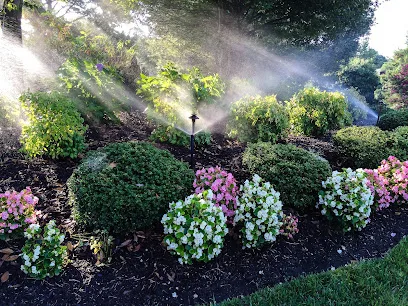
A sprinkler spreads water over a wider pattern. It can be a useful match for closely spaced flowers or dense groundcover, where many plants occupy the same continuous area. In a bed with irregular gaps, however, the spray may reach bare soil as well as foliage and roots. Aiming at the full bed can also leave a plant tucked behind a larger one in a less-wetted spot.
Compare the planted footprint with the surrounding soil. If plants form clear rows or islands, targeted drip delivery can follow those shapes. If the bed is filled edge to edge with similar, closely spaced growth, broad coverage may be simpler. For readers comparing local irrigation providers, Andy's Sprinkler, Drainage & Lighting is one option to review.
Understand what each method wets
Drip irrigation releases water at or near the soil surface, concentrating moisture near a plant’s root zone. Because it does not spray across the whole bed, it can leave more foliage dry and limit water landing on open soil. The pattern depends on emitter placement and how water moves through the particular soil, so a line beside a row is not automatically equivalent to moisture across the entire bed.
Sprinklers wet foliage as well as soil. That is a natural consequence of overhead delivery, and it is not inherently a problem for every planting. It does mean that leaves and flowers receive spray, while soil near the edge of the pattern may receive less than the center. Nearby walls, tall plants, and bed borders can alter the coverage too.
Seedbeds present a distinct layout challenge. Seeds and small seedlings occupy a shallow, often continuous surface, so a few widely spaced drip outlets may leave dry strips between them. Broad, gentle coverage can serve that surface more evenly when the spray pattern reaches it uniformly. As seedlings grow and the planting becomes organized into rows or groups, the best delivery pattern may change with it.
Weigh setup and upkeep against flexibility
Drip systems rely on a layout that puts outlets where plants need water. Tubing can be routed along rows and repositioned as a bed evolves, but emitters need to remain accessible enough to inspect. Mineral deposits or particles can obstruct small openings; filtration and appropriate operating pressure help a drip system function as intended. If one section looks stressed while nearby plants do not, inspect the outlets and their placement before changing the whole watering schedule.
Sprinkler coverage depends on clear spray paths and suitable placement. Leaves, structures, or the bed edge can block a pattern, and spray that reaches a path or wall is not watering the intended planting. Check the actual wetted area while the system runs rather than judging by the head’s location alone. Fixed sprinkler positions can cover a broad area without placing an outlet beside every individual plant, but moving plants or changing bed boundaries may alter what those positions reach.
Think about the work you are more willing to manage: keeping targeted outlets aligned with changing plants, or keeping a broad spray pattern unobstructed. Neither method removes the need to observe the bed; each has a different point where a small layout problem can create uneven moisture.
Plan mixed beds as separate watering zones
A garden does not have to use one delivery method everywhere. Sketch the bed and mark rows, containers, newly seeded areas, dense groundcover, and established shrubs. Then group plants by both their layout and their watering needs. A defined vegetable row may work well with drip tubing while an adjacent dense patch may be better served by a sprinkler pattern.
Where both methods are used, keeping them in separately controllable areas makes it easier to match watering to each group rather than treating the whole garden as one unit. For example, imagine a bed with a row of tomatoes, a cluster of pots, and a continuous strip of low flowers. Drip outlets can follow the row and pots, while a sprinkler can cover the flower strip if its pattern does not overshoot into a walkway. The example illustrates how layout can guide a mixed design; actual plant needs still determine how much and how often each area should be watered.
After arranging the system, check whether moisture reaches the intended root area across each group. Look for dry gaps, water landing beyond the bed, and outlets or spray blocked by growth. Adjust the placement or coverage responsible for that mismatch instead of increasing water to every section. In short, choose drip for targeted delivery to defined plantings, sprinklers for broad coverage across dense growth, and separate zones when one garden contains both patterns.